
Basic Math PDF: An Overview
Basic Math PDFs offer accessible learning, encompassing arithmetic, algebra, and geometry fundamentals. These resources, ranging from free online PDFs to paid comprehensive guides, cater to diverse learning needs.
Visual Basic and BASIC language origins trace back to Dartmouth College, designed for beginners, while modern applications address licensing issues like STEP 7 Basic.
What is Basic Math?
Basic math represents the foundational building blocks of numerical literacy, encompassing core arithmetic operations and serving as a stepping stone to more advanced mathematical concepts. It’s the essential skillset for everyday life, from managing finances to understanding measurements. A basic math PDF typically focuses on these fundamental principles, offering a structured approach to learning.
Historically, languages like BASIC were designed to make programming, and by extension, mathematical problem-solving, accessible to beginners. While modern computing has evolved, the core principles of basic math remain constant. These PDFs often cover topics like whole numbers, fractions, decimals, percentages, and introductory algebra – variables and expressions – mirroring the simplicity of early programming languages.
Understanding basic math isn’t just about memorizing formulas; it’s about developing logical thinking and problem-solving skills. Resources like STEP 7 Basic demonstrate the application of these principles in technical fields, highlighting the enduring relevance of these foundational concepts. The availability of free online PDFs and paid comprehensive guides ensures accessibility for all learners.
Why Use a Basic Math PDF?
Basic Math PDFs offer unparalleled convenience and accessibility for learners of all levels. Unlike traditional textbooks, they are readily available for download, eliminating the need for costly purchases and physical storage. This digital format allows for learning on-the-go, utilizing various devices like tablets and smartphones.
These PDFs often provide a structured learning path, covering essential topics from arithmetic to introductory algebra – mirroring the foundational approach of languages like BASIC. They can be particularly helpful for self-paced learning, allowing individuals to revisit concepts as needed. Troubleshooting guides, like those addressing STEP 7 Basic licensing, demonstrate the practical application of mathematical skills.
Furthermore, Basic Math PDFs can supplement classroom learning or serve as a refresher for those returning to the subject. Whether utilizing free online PDFs or investing in paid comprehensive guides, learners benefit from a focused and readily available resource. The simplicity of the format echoes the original intent of BASIC – making learning accessible to everyone.
Core Arithmetic Operations
Basic Math PDFs fundamentally focus on mastering core arithmetic operations – the building blocks of all mathematical understanding. These include addition, subtraction, multiplication, and division, presented with clear explanations and numerous practice problems. A solid grasp of these operations is akin to understanding the foundational principles of a programming language like BASIC, essential for more complex tasks.
PDF resources often break down these operations into manageable steps, catering to different learning styles. They emphasize understanding why the operations work, not just how to perform them. This approach is crucial, as even troubleshooting software licenses, like with STEP 7 Basic, requires logical thinking rooted in arithmetic.
Many Basic Math PDFs also introduce the concept of order of operations (PEMDAS/BODMAS) and the properties of numbers. Whether utilizing free online PDFs or paid comprehensive guides, the goal is to establish a strong foundation for future mathematical endeavors, mirroring the importance of a stable base in any system, even those built with Visual Basic.
Addition and Subtraction
Basic Math PDFs dedicate significant attention to addition and subtraction, the most fundamental arithmetic operations. These resources typically begin with simple, single-digit problems, gradually increasing complexity to include multi-digit numbers, decimals, and even negative numbers. The emphasis is on understanding the concepts of combining quantities (addition) and finding the difference (subtraction).
Effective Basic Math PDFs utilize visual aids, like number lines and manipulatives, to illustrate these operations. They also address common errors and misconceptions, providing targeted practice to reinforce correct techniques. This methodical approach mirrors the structured learning often found in introductory programming languages like BASIC.
Whether accessing free online PDFs or investing in paid comprehensive guides, learners will encounter real-world applications of addition and subtraction. These examples help solidify understanding and demonstrate the practical relevance of these skills, much like understanding the core logic behind troubleshooting issues like STEP 7 Basic licensing.

Multiplication and Division
Basic Math PDFs thoroughly cover multiplication and division, building upon the foundation of addition and subtraction. These resources often introduce multiplication as repeated addition, visually demonstrating how it streamlines calculations with larger numbers. Similarly, division is explained as the process of splitting a quantity into equal groups, often linked to the inverse operation of multiplication.
A quality Basic Math PDF will present multiplication tables for memorization and efficient problem-solving. It will also detail long multiplication and long division algorithms, breaking down complex procedures into manageable steps. Like learning the syntax of BASIC, mastering these algorithms requires practice and understanding of underlying principles.
The best free online PDFs and paid comprehensive guides connect these operations to real-world scenarios, such as calculating areas or sharing resources. Understanding these concepts is crucial, mirroring the systematic approach needed to resolve issues like STEP 7 Basic license errors, demanding a logical and methodical mindset.
Understanding Fractions
Basic Math PDFs dedicate significant space to fractions, explaining them as parts of a whole. These resources typically begin by visually representing fractions – using pies, bars, or sets – to illustrate the numerator (parts considered) and the denominator (total parts). A strong Basic Math PDF emphasizes that fractions represent division, linking them back to previously learned operations.
The materials will often compare learning fractions to mastering a programming language like BASIC; both require understanding fundamental components and how they interact. They’ll detail proper, improper, and mixed fractions, providing examples for each. Like troubleshooting a STEP 7 Basic license issue, understanding the type of fraction is the first step to solving problems.
Good free online PDFs and paid comprehensive guides will also cover equivalent fractions, demonstrating how multiplying or dividing both numerator and denominator by the same number doesn’t change the fraction’s value. This concept is vital for simplifying fractions and performing operations with them.
Types of Fractions
Basic Math PDFs thoroughly categorize fractions into distinct types, beginning with proper fractions where the numerator is less than the denominator (e.g., 1/2, 3/4). These represent values less than one. Conversely, improper fractions have numerators larger than denominators (e.g., 5/4, 7/3), representing values greater than or equal to one.
A crucial element covered in these PDFs is mixed numbers – a combination of a whole number and a proper fraction (e.g., 1 1/2, 2 3/4). Understanding the conversion between improper fractions and mixed numbers is emphasized, akin to navigating the complexities of Visual Basic code or resolving a STEP 7 Basic licensing error – a systematic process is key.
Free online PDFs and paid comprehensive guides often include examples and exercises to solidify understanding. They may also introduce unit fractions (numerator of 1) and their role in decomposing other fractions. Mastering these distinctions is foundational for further mathematical operations, much like grasping the basics of the BASIC language itself.
Simplifying Fractions
Basic Math PDFs dedicate significant attention to simplifying fractions, a core skill for efficient calculations. This process, also known as reducing fractions, involves dividing both the numerator and denominator by their greatest common factor (GCF). Resources emphasize finding the GCF, often illustrating methods like listing factors or using prime factorization.
These PDFs demonstrate how simplification doesn’t alter the fraction’s value, merely presenting it in its lowest terms. Similar to debugging code in Visual Basic or troubleshooting a STEP 7 Basic license issue, simplification aims for the most concise and accurate representation.

Free online PDFs and paid comprehensive guides provide numerous examples, progressing from simple cases (e.g., 2/4 simplifying to 1/2) to more complex scenarios. They often highlight the importance of checking for common factors before dividing. Mastering simplification is crucial for subsequent operations like addition and multiplication, mirroring the foundational importance of the BASIC language in programming.
Working with Decimals
Basic Math PDFs thoroughly cover working with decimals, building upon the understanding of fractions and place value. These resources explain decimal place value – tenths, hundredths, thousandths, and beyond – emphasizing the positional notation system. They demonstrate how to read, write, and compare decimals, often using real-world examples like monetary values or measurements.
A key focus is performing arithmetic operations (addition, subtraction, multiplication, and division) with decimals. PDFs illustrate aligning decimal points for addition and subtraction, and counting decimal places for multiplication and division. Similar to resolving a Microsoft Visual Basic error or a STEP 7 Basic licensing problem, precision is paramount.
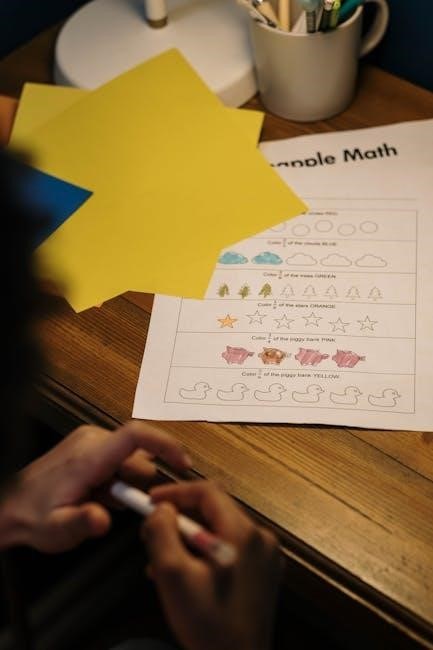
Free online PDFs and paid comprehensive guides often include exercises to reinforce these skills. They also explore rounding decimals and converting between decimals and fractions, linking these concepts to the fundamentals of the BASIC language and its logical operations.
Decimal Place Value

Basic Math PDFs dedicate significant attention to understanding decimal place value, a cornerstone of numerical literacy. These resources meticulously explain how each digit’s position to the right of the decimal point represents a decreasing power of ten – tenths, hundredths, thousandths, and so on. Visual aids and examples, similar to troubleshooting a STEP 7 Basic license issue, are frequently employed to clarify this concept.
PDFs demonstrate how to identify the place value of any digit within a decimal number. They emphasize that the decimal point separates the whole number portion from the fractional portion. This understanding is crucial for accurately comparing decimals and performing arithmetic operations, much like mastering the fundamentals of the BASIC language.
Free online PDFs and paid comprehensive guides often include practice exercises to reinforce place value recognition. They may also connect this concept to real-world applications, such as measuring length or calculating monetary amounts, mirroring the precision required in Microsoft Visual Basic coding.
Converting Between Fractions and Decimals
Basic Math PDFs thoroughly cover the conversion between fractions and decimals, a vital skill for numerical fluency. These guides detail how to convert fractions to decimals through division – dividing the numerator by the denominator. Conversely, they explain converting decimals to fractions by identifying the place value and expressing it as a denominator, similar to resolving a STEP 7 Basic licensing error.
Free online PDFs often provide step-by-step examples, illustrating both conversion methods. Paid comprehensive guides may include more complex scenarios, like converting repeating decimals to fractions. Understanding this process is akin to grasping the core principles of the BASIC language – a foundational element for further mathematical exploration.
The resources emphasize recognizing equivalent forms, demonstrating that a fraction and its decimal representation can express the same value. This skill is crucial for problem-solving and building a strong mathematical foundation, much like the precision demanded in Microsoft Visual Basic programming.
Basic Math PDFs dedicate significant space to percentages, explaining them as a ratio expressed out of 100. These resources clarify that “percent” literally means “per hundred,” providing a clear conceptual foundation. They demonstrate how to represent portions of a whole using percentages, linking it to real-world applications like discounts and taxes.
Free online PDFs typically begin with simple examples, illustrating how to convert fractions and decimals to percentages, and vice versa – a skill mirroring the conversion processes within the BASIC language. Paid comprehensive guides delve into more complex scenarios, such as percentage increase and decrease calculations.
Understanding percentages is presented as fundamental, much like mastering the basic skills of reading and writing. The guides often draw parallels to everyday life, making the concept relatable. Troubleshooting issues, like a STEP 7 Basic license error, requires a similar attention to detail and proportional thinking.
Calculating Percentages
Basic Math PDFs thoroughly cover percentage calculation techniques, starting with the core formula: (Part / Whole) x 100. They demonstrate finding a percentage of a given number, a skill crucial for understanding discounts and sales tax, much like the foundational elements of BASIC programming.
Free online PDFs often provide step-by-step examples, while paid comprehensive guides include practice problems with varying difficulty levels. These resources emphasize the importance of correctly identifying the ‘part’ and the ‘whole’ in word problems, a common stumbling block for learners.
The guides also explain how to calculate percentage increase or decrease, mirroring the iterative processes found in Visual Basic. Troubleshooting, like resolving a STEP 7 Basic licensing issue, requires a similar analytical approach. Mastering these calculations builds a strong foundation for more advanced mathematical concepts, akin to acquiring basic skills.

Percentage Applications
Basic Math PDFs demonstrate the practical relevance of percentages across various real-world scenarios. These resources illustrate applications in finance – calculating interest, loan payments, and investment returns – mirroring the problem-solving approach needed for STEP 7 Basic license troubleshooting.
Free online PDFs often feature examples related to retail, such as determining sale prices and discounts, while paid comprehensive guides delve into more complex applications like calculating tax rates and commission. Understanding these concepts is akin to grasping the fundamentals of BASIC programming, building from simple to complex.
Furthermore, Basic Math PDFs cover percentage applications in statistics, like interpreting data and calculating probabilities. Just as Visual Basic requires precise coding, accurate percentage calculations are vital for informed decision-making. These guides emphasize the importance of applying the correct formula and interpreting the results correctly, fostering analytical skills.
Basic Algebra Concepts
Basic Math PDFs introduce fundamental algebraic principles, building upon arithmetic foundations. These resources explain variables and expressions, demonstrating how letters represent unknown quantities, much like understanding the core of the BASIC language itself. They often include step-by-step guides for solving simple equations, emphasizing the importance of isolating the variable.
Free online PDFs typically cover introductory topics like combining like terms and applying the distributive property, while paid comprehensive guides delve into more complex equation types and inequalities. This progression mirrors the evolution from simple Visual Basic code to more sophisticated applications.
The best Basic Math PDFs connect algebra to real-world problems, illustrating how equations can model practical situations. Just as troubleshooting STEP 7 Basic licensing requires logical thinking, mastering algebra demands a systematic approach to problem-solving, fostering critical thinking skills;
Variables and Expressions

Basic Math PDFs dedicate significant space to explaining variables and expressions, the building blocks of algebra. A variable, represented by a letter (like ‘x’ or ‘y’), symbolizes an unknown value, a concept akin to the flexibility within the BASIC language. Expressions combine variables, numbers, and operations (+, -, ×, ÷) without an equals sign.
These PDFs often use practical examples to illustrate how to translate word problems into algebraic expressions. For instance, “a number increased by five” becomes “x + 5”. Understanding this translation is crucial, mirroring the process of converting ideas into Visual Basic code.
Free online PDFs typically focus on identifying variables and simplifying expressions, while paid comprehensive guides expand to include evaluating expressions by substituting values for variables. Troubleshooting issues like STEP 7 Basic licensing also requires identifying key components – a similar skill!
Solving Simple Equations
Basic Math PDFs thoroughly cover solving simple equations, building upon the concepts of variables and expressions. An equation, unlike an expression, does contain an equals sign (=), stating that two expressions are equivalent. The goal is to isolate the variable to determine its value.
These resources emphasize the importance of maintaining balance – whatever operation is performed on one side of the equation must also be performed on the other. This mirrors the precision needed when working with Visual Basic or troubleshooting STEP 7 Basic licensing errors.
Free online PDFs usually focus on one-step equations (e.g., x + 3 = 7), while paid comprehensive guides delve into multi-step equations and introduce concepts like inverse operations. The BASIC language’s straightforward nature parallels the logical steps involved in equation solving, making it an accessible starting point for learners.

Geometry Fundamentals
Basic Math PDFs dedicate sections to Geometry Fundamentals, introducing basic shapes like squares, rectangles, triangles, and circles. These resources explain their defining properties – sides, angles, and vertices – laying the groundwork for more complex geometric concepts.

A key focus is on area and perimeter calculations. PDFs provide formulas and worked examples, demonstrating how to apply them to real-world scenarios. Understanding these calculations is akin to debugging code in Visual Basic; precision and attention to detail are crucial.
Free online PDFs often present visual aids and interactive exercises, while paid comprehensive guides offer more in-depth coverage, including volume calculations and geometric proofs. The logical structure of geometry mirrors the systematic approach required when resolving STEP 7 Basic licensing issues, emphasizing a step-by-step methodology.
Basic Shapes and Their Properties
Basic Math PDFs thoroughly cover basic shapes, starting with two-dimensional figures like circles, squares, rectangles, and triangles. These resources detail each shape’s unique properties, including the number of sides, angles, and vertices. Understanding these attributes is fundamental, much like grasping the core principles of the BASIC language itself.
PDFs explain how to identify and classify shapes based on these characteristics. Three-dimensional shapes, such as cubes, spheres, and cylinders, are also introduced, with explanations of their surfaces and volumes. This foundational knowledge is crucial, similar to troubleshooting issues with STEP 7 Basic, requiring a clear understanding of components.
Free online PDFs often utilize visual representations, while paid comprehensive guides provide detailed diagrams and proofs. The precision required in defining shape properties echoes the meticulous nature of Visual Basic coding, demanding accuracy and attention to detail.
Area and Perimeter Calculations
Basic Math PDFs dedicate significant attention to area and perimeter calculations for various shapes. These guides provide formulas and step-by-step examples for determining the space enclosed within a shape (area) and the total distance around its exterior (perimeter). This builds upon the understanding of basic shapes and their properties.
PDFs cover calculations for rectangles, squares, triangles, circles, and more complex polygons. They often include practical applications, demonstrating how these concepts are used in real-world scenarios, much like the practical utility of the BASIC language in early computing.
Free online PDFs may offer simplified explanations, while paid comprehensive guides delve into more complex problems and proofs. Mastering these calculations is essential, mirroring the precision needed when working with Visual Basic or resolving licensing issues like those encountered with STEP 7 Basic, demanding accurate application of rules.

Resources for Basic Math PDFs
Numerous resources offer Basic Math PDFs, catering to diverse learning preferences and budgets. Free online PDFs are readily available from educational websites, Khan Academy, and open educational resource repositories. These often provide introductory material and practice exercises, similar to the initial accessibility of the BASIC language itself.
For more in-depth coverage, paid comprehensive guides are available through platforms like Amazon, educational publishers, and specialized math resource websites. These often include detailed explanations, worked examples, and practice problems with solutions. The availability mirrors the evolution from Visual Basic to more robust programming environments.
Troubleshooting resources, akin to resolving STEP 7 Basic licensing issues, can be found on forums and support pages. These resources help navigate potential difficulties accessing or utilizing PDF materials, ensuring a smooth learning experience.
Free Online PDFs
Free Basic Math PDFs are abundant online, offering accessible learning opportunities for students of all ages. Websites like Khan Academy and various educational institutions provide downloadable PDFs covering core arithmetic, introductory algebra, and fundamental geometry concepts. These resources often mirror the initial simplicity of the BASIC programming language, designed for beginners.
Many universities and colleges openly share course materials, including comprehensive Basic Math PDFs, as part of their open educational resource initiatives. These PDFs frequently include practice problems, solutions, and detailed explanations, similar to the structured learning approach of Visual Basic tutorials.
However, users should exercise caution and verify the source’s credibility, akin to troubleshooting STEP 7 Basic license issues, to ensure the accuracy and quality of the content. These free resources provide a valuable starting point for mastering essential mathematical skills.
Paid Comprehensive Guides
Paid Basic Math PDFs typically offer a more structured and in-depth learning experience compared to free resources. These guides often include extensive practice problems, detailed solution manuals, and supplementary materials like video tutorials or online quizzes. They frequently cover a broader range of topics, extending beyond basic arithmetic to include pre-algebra and introductory calculus concepts, mirroring the expanded capabilities of Visual Basic.
Reputable publishers and educational companies curate these comprehensive PDFs, ensuring accuracy and pedagogical soundness. Similar to resolving STEP 7 Basic licensing errors, investing in a quality guide can save time and frustration. These resources often feature clear explanations and step-by-step instructions, catering to diverse learning styles.
While representing a financial investment, paid guides provide a focused and reliable pathway to mastering basic math, often exceeding the scope of introductory materials like the original BASIC language.