
Moral philosophy delves into defining ‘right’ and ‘wrong,’ examining how we ought to live, as explored in foundational texts like James Rachels’ work.
Defining Morality and its Importance
Morality, at its core, concerns principles distinguishing right from wrong, guiding our conduct. As highlighted in resources like James Rachels’ Elements of Moral Philosophy, this isn’t a trivial pursuit; it’s about “how we ought to live.”
Understanding morality is crucial because it shapes societal norms, personal values, and legal systems. The field acknowledges differing cultural codes – a key observation – yet seeks universal principles.
Ignoring moral considerations leads to societal breakdown and individual conflict. Exploring these concepts, as the provided materials suggest, isn’t naïve, but essential for reasoned discourse and ethical decision-making in a complex world. It’s a fundamental inquiry into the human condition.

The Scope of Moral Philosophy
Moral philosophy’s scope is remarkably broad, extending beyond simple “right” versus “wrong” judgments. It encompasses meta-ethics – exploring the meaning of moral language – normative ethics – establishing moral standards – and applied ethics, addressing specific issues.
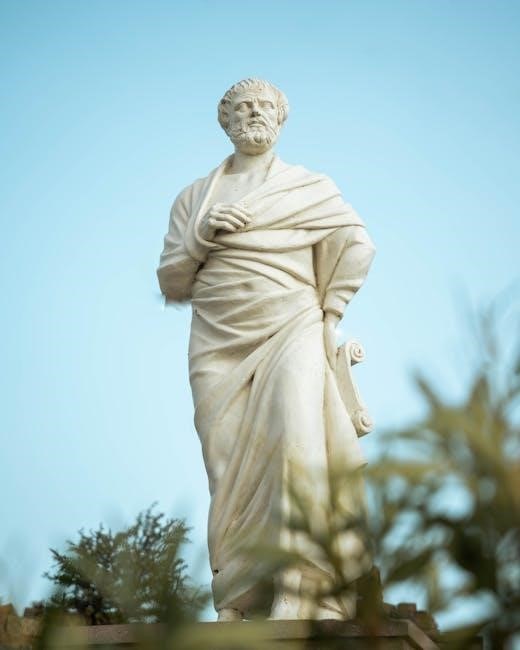
Resources like Rachels’ work demonstrate this breadth, touching upon justice, rights, and liberty. The field investigates the foundations of moral beliefs, considering whether they are objective, subjective, or culturally relative.

Furthermore, it delves into moral motivation, examining why we should be moral, and the connection between freedom and moral responsibility. The scope isn’t limited to abstract theory; it actively engages with contemporary dilemmas in bioethics and beyond.

Historical Foundations of Moral Thought
Ancient thinkers like Socrates and Plato, referenced in foundational texts, initiated Western moral inquiry, questioning the nature of justice and the good life.
Socrates and Plato’s Contributions
Socrates, through relentless questioning – as documented in Plato’s Republic – challenged conventional morality, insisting on self-examination to define ethical living. He believed understanding virtue was paramount to a fulfilling life.
Plato, Socrates’ student, expanded upon these ideas, proposing the Theory of Forms, suggesting a realm of perfect ideals influencing our perceived reality. Moral knowledge, for Plato, involved grasping these Forms, particularly the Form of the Good.
Their dialogues explored justice, piety, and courage, laying the groundwork for subsequent ethical theories. These early explorations, central to the elements of moral philosophy, emphasized reason and the pursuit of objective moral truths, moving beyond mere societal norms.
Aristotle’s Virtue Ethics
Aristotle diverged from Plato, grounding morality in practical reason and human flourishing – eudaimonia. He argued virtues aren’t innate but cultivated through habit and practice, representing a “golden mean” between two extremes.
For example, courage lies between recklessness and cowardice. Developing virtues like honesty, generosity, and justice is essential for a well-lived life.
Unlike rule-based systems, virtue ethics focuses on being a moral person rather than simply doing the right thing. This approach, a core component of the elements of moral philosophy, emphasizes character development and the pursuit of excellence, shaping actions through reasoned judgment and habitual goodness.
The Influence of Ancient Greek Philosophy
Ancient Greek philosophy profoundly shaped Western moral thought, initiating systematic inquiry into ethics. Socrates challenged conventional beliefs, emphasizing self-examination and the pursuit of knowledge as crucial for a virtuous life – a cornerstone explored within the elements of moral philosophy.
Plato, his student, expanded on this, proposing a theory of Forms, where true morality resides in an ideal realm.
These ideas laid the groundwork for later ethical systems, influencing concepts of justice, goodness, and the ideal state. Their emphasis on reason, virtue, and the good life continues to resonate in contemporary moral debates, providing a historical context for understanding current ethical frameworks.

Key Theories in Moral Philosophy
Moral philosophy presents diverse theories – utilitarianism, Kantian ethics, and Rawls’ theory of justice – each offering unique perspectives on moral principles and actions.
Utilitarianism: Maximizing Happiness
Utilitarianism, a cornerstone of moral philosophy, centers on maximizing overall happiness and well-being. This consequentialist theory judges actions based on their outcomes, striving for the greatest good for the greatest number.
The provided resources highlight objections to utilitarianism, suggesting complexities in its application. Determining what truly constitutes “happiness” and accurately predicting consequences pose significant challenges. Furthermore, utilitarian calculations can sometimes justify actions that seem intuitively unjust or violate individual rights.
Exploring different approaches within utilitarianism, such as act utilitarianism (focusing on individual actions) versus rule utilitarianism (emphasizing general rules), reveals nuanced perspectives on achieving optimal outcomes. Understanding these distinctions is crucial for a comprehensive grasp of this influential ethical framework.
Act Utilitarianism vs. Rule Utilitarianism
Act utilitarianism assesses each individual action based on whether it maximizes happiness in that specific instance. It’s a case-by-case evaluation, potentially leading to inconsistent moral judgments. Conversely, rule utilitarianism focuses on establishing general rules that, when consistently followed, will maximize overall happiness.
The distinction lies in the scope of application. Act utilitarianism is concerned with immediate consequences, while rule utilitarianism prioritizes long-term societal well-being. A rule might forbid lying, even if a single lie could produce a better outcome in a particular situation, as upholding truthfulness generally fosters trust and happiness.
This divergence addresses concerns about the potential for act utilitarianism to justify morally questionable actions if they happen to yield positive results in a given context.
Objections to Utilitarianism
Utilitarianism faces several criticisms. One key objection concerns justice and rights. The pursuit of maximizing overall happiness could potentially justify sacrificing the well-being of a minority for the benefit of the majority – a scenario many find morally unacceptable.
Another challenge relates to the difficulty of accurately predicting consequences and measuring happiness. How do we compare the happiness of different individuals, and can we truly foresee all the ramifications of our actions? Furthermore, utilitarianism can be demanding, requiring constant calculation and potentially neglecting personal commitments.
These concerns highlight the complexities of applying a purely consequentialist ethical framework in real-world situations, prompting exploration of alternative moral theories.
Kantian Moral Philosophy: Deontology
Immanuel Kant’s moral philosophy, known as deontology, centers on duty and universal moral laws, differing from consequentialist approaches. Moral actions aren’t judged by their outcomes, but by adherence to these laws, which are derived from reason.
Central to Kantian ethics is the Categorical Imperative, a principle demanding we act only according to rules that could become universal laws. This emphasizes consistency and impartiality. The Formula of Humanity dictates treating individuals as ends in themselves, never merely as means to an end – respecting their inherent dignity.
Kant believed moral duties are absolute and binding, regardless of personal desires or consequences, offering a robust framework for ethical decision-making.
Categorical Imperative and Universal Law
Kant’s Categorical Imperative is the cornerstone of his deontology, demanding moral actions be guided by principles applicable to everyone, everywhere. This “universalizability” test asks: could this maxim become a universal law without contradiction?
For example, a promise broken for personal gain cannot be universalized; if everyone broke promises, trust would collapse, rendering the very act self-defeating. The Formula of Universal Law compels us to act only according to maxims we would will to become universal laws.
This isn’t about predicting consequences, but logical consistency. It’s a rigorous standard, demanding impartiality and respect for rational agency in all moral judgments.
The Formula of Humanity
Kant’s Formula of Humanity dictates we should always treat humanity, whether in our own person or that of another, never merely as a means to an end, but always at the same time as an end. This emphasizes inherent human dignity and rational autonomy.
Exploitation, manipulation, or deception violate this principle, as they instrumentalize individuals, disregarding their intrinsic worth. Genuine moral action respects the capacity for rational choice in all people.
It’s not about avoiding all use of others – cooperation inherently involves some degree of means-end reasoning – but ensuring their rational agency is simultaneously acknowledged and valued. This formula provides a powerful ethical constraint.
Rawls’ Theory of Justice
John Rawls’s influential theory, outlined in “A Theory of Justice,” centers on fairness and equality. He proposes principles of justice individuals would agree to in an “original position” behind a “veil of ignorance,” unaware of their future social standing.
This thought experiment aims to eliminate bias, leading to impartial principles. Rawls argues for two primary principles: equal basic liberties for all, and social and economic inequalities arranged to benefit the least advantaged, with opportunities open to everyone.
These principles prioritize protecting fundamental rights and mitigating societal disparities, establishing a framework for a just and equitable society.
Principles of Justice
Rawls’s first principle guarantees each person an equal right to the most extensive basic liberty compatible with similar liberty for others. This encompasses political freedoms like voting and due process, and personal freedoms like speech and association.
The second principle addresses socioeconomic inequalities. It operates in two parts: the difference principle, allowing inequalities only if they benefit the least advantaged, and fair equality of opportunity, requiring positions and offices to be open to all under conditions of fair competition.
These principles, derived from the original position, aim to create a just society where basic rights are protected and disparities are minimized, fostering a more equitable distribution of resources and opportunities.
Arguments for the Principles of Justice
Rawls argues these principles would be chosen from an “original position” of equality, behind a “veil of ignorance” – where individuals don’t know their future social status, talents, or beliefs.
This ensures impartiality; rational individuals would prioritize securing basic liberties and minimizing risk of disadvantage. The difference principle arises because risk-averse individuals would prefer a guaranteed minimum, even if it means some inequality benefiting all.
Furthermore, fair equality of opportunity is crucial for maintaining social stability and preventing resentment. Rawls contends these principles represent a stable and justifiable foundation for a just and well-ordered society, promoting fairness and mutual respect.

Cultural Relativism and Moral Diversity
Cultural relativism acknowledges differing moral codes across cultures, suggesting values aren’t universal, as highlighted in texts like Rachels’ exploration of morality.
Understanding Cultural Differences in Morality
Exploring diverse moral landscapes is central to understanding cultural relativism, a concept thoroughly examined in resources like James Rachels’ The Elements of Moral Philosophy. The text emphasizes that assuming universal values is naive, as different cultures possess distinct moral codes.
This doesn’t necessarily imply moral inferiority, but rather highlights the influence of societal norms and historical context on ethical frameworks. Recognizing these differences is crucial for avoiding ethnocentrism and fostering respectful dialogue. The core idea suggests morality is not absolute, but rather shaped by cultural perspectives, prompting critical reflection on our own beliefs and values.
Acknowledging this diversity is the first step towards a nuanced understanding of global ethics.
Challenges to Cultural Relativism
Despite its appeal, cultural relativism faces significant challenges, as explored within The Elements of Moral Philosophy. A primary critique centers on its potential to legitimize harmful practices. If morality is solely determined by culture, condemning practices like oppression or injustice becomes problematic, as they might be culturally accepted.
Furthermore, the theory struggles with the possibility of moral progress. If each culture’s beliefs are equally valid, how can we assess whether one society is morally improving over another? This raises concerns about universal human rights and the ability to criticize harmful cultural norms.
These difficulties prompt a search for a balance between respecting cultural diversity and upholding fundamental moral principles.

Rights and Justice
Rights are defined as moral claims recognized by society, while justice aims for fairness – concepts central to moral philosophy, as detailed in relevant PDFs.
The Concept of Rights
Rights, within moral philosophy, represent fundamental moral claims individuals possess and society acknowledges. Bosanquet defines them as claims upheld by societal authority, ensuring favorable conditions. These aren’t absolute; rights are often contextual and not unconditional, reflecting societal limitations and competing interests.
Exploring PDFs on moral philosophy reveals a nuanced understanding of rights, moving beyond simple entitlements. They are intrinsically linked to justice and liberty, forming the bedrock of ethical considerations. Understanding the scope and limitations of rights is crucial for navigating complex moral dilemmas and building a just society. The recognition of these claims is paramount.
Different Types of Rights
Moral philosophy categorizes rights in various ways, though specific classifications aren’t explicitly detailed in the provided excerpts. However, the core concept suggests a spectrum ranging from basic liberties – freedoms from interference – to positive entitlements requiring societal provision.
Considering the emphasis on justice, equality, and social justice within the referenced materials, we can infer distinctions between individual and collective rights. Furthermore, legal rights, enforced by systems of governance, differ from moral rights, grounded in ethical principles. Exploring PDFs on this topic reveals a complex interplay between these categories, shaping our understanding of fairness and obligation within a society.
Justice as Fairness
John Rawls’ theory, referenced in the provided texts, posits “justice as fairness” as a cornerstone of moral philosophy. This concept centers on establishing principles of justice that rational individuals would agree upon from behind a “veil of ignorance,” unaware of their future social standing.
The excerpts highlight the importance of fundamental ideas and arguments supporting these principles. While specifics aren’t detailed, the emphasis on rights, equality, and social justice suggests Rawlsian justice prioritizes equitable distribution and protection for all members of society. This framework aims to mitigate inherent biases and ensure a just societal structure, fostering a sense of fairness and mutual respect.

Moral Motivation and Freedom
Moral action requires powerful motivation, and the principle “ought implies can” suggests freedom is essential for genuine moral responsibility, as explored in texts.
The Role of Motivation in Moral Action
Moral philosophy profoundly investigates the driving forces behind ethical behavior. Texts emphasize that simply knowing what is right isn’t sufficient; individuals must be motivated to act accordingly. This motivation isn’t merely external pressure, but a deeply held internal commitment.
The sufficiency of moral motivation is a key debate, questioning whether a genuine understanding of morality automatically generates the desire to be moral. Furthermore, the provided resources highlight that moral motivation is considered crucial, powerful, and even inspiring. Without this internal impetus, moral principles remain abstract ideals, disconnected from practical application and genuine ethical conduct.
Understanding this role is vital for assessing the feasibility and effectiveness of ethical systems.
Ought Implies Can
A central tenet within moral philosophy, and specifically highlighted in relevant texts, is the principle of “ought implies can.” This foundational idea asserts that moral obligations are only meaningful if the individual is able to fulfill them. It’s logically inconsistent to demand someone do something they are genuinely incapable of achieving.
Essentially, if we say someone “ought” to perform an action, we implicitly acknowledge their capacity to do so. This principle addresses the complexities of moral responsibility, recognizing limitations imposed by circumstance, ability, or external constraints.
Without this qualification, moral judgments become both unfair and unproductive, potentially leading to blame where no genuine agency exists. This concept is crucial for a nuanced understanding of free will and moral accountability.
Moral Motivation and Free Will
The connection between moral motivation and free will is a cornerstone of ethical debate, as explored in philosophical resources. Genuine moral action isn’t merely knowing what’s right, but being compelled to do it. A powerful, inspiring motivation is considered crucial for consistent ethical behavior.
However, the question arises: does free will even exist? If our actions are predetermined, can we truly be held morally responsible? The “sufficiency of moral motivation” suggests that recognizing a moral obligation should, in itself, provide the impetus for action.
This perspective links moral understanding directly to agency, implying that a truly moral person will act morally, given sufficient understanding. The debate continues regarding the extent to which our will is truly ‘free’ versus influenced by external factors.

Contemporary Issues in Moral Philosophy
Applied ethics, including bioethics and environmental concerns, dominates current discussions, building upon established moral frameworks and demanding new considerations.
Applied Ethics: Bioethics, Environmental Ethics
Applied ethics represents a crucial contemporary focus, extending theoretical moral principles to practical dilemmas. Bioethics grapples with complex issues arising from advancements in medicine and biotechnology – questions of life, death, and patient autonomy. Simultaneously, environmental ethics addresses humanity’s moral responsibilities towards the natural world, considering sustainability and the rights of future generations.
These fields demand careful consideration of competing values and often lack easy answers. The core principles explored in foundational texts, like those by James Rachels, provide frameworks for analyzing these challenges. Understanding differing cultural perspectives, as highlighted in discussions of cultural relativism, becomes vital when navigating global ethical concerns within these applied domains.
The Future of Moral Philosophy
Moral philosophy’s future lies in continued engagement with evolving societal challenges. Emerging technologies, like artificial intelligence, present novel ethical dilemmas demanding rigorous analysis. A key direction involves bridging the gap between abstract theory and practical application, as seen in fields like bioethics and environmental ethics.
Further exploration of cultural relativism and universal moral principles remains vital, fostering cross-cultural understanding. The ongoing debate surrounding rights, justice, and motivation—concepts central to thinkers like Rawls and Kant—will undoubtedly shape future discourse. Texts like James Rachels’ “Elements of Moral Philosophy” will continue to serve as foundational resources for navigating these complex issues.